Identity verification
BetPanda KYC and Verification
 Available in GB
BetPanda currently describes a conditional-KYC model rather than full identity verification at signup. Its 2026 official guidance says most users can register with email or wallet access and start without uploading documents, while verification can be triggered later by events such as a large withdrawal, anti-money-laundering flags, suspicious activity, multi-accounting or bonus abuse. That means “no KYC” is not a guarantee that an account will never be reviewed.
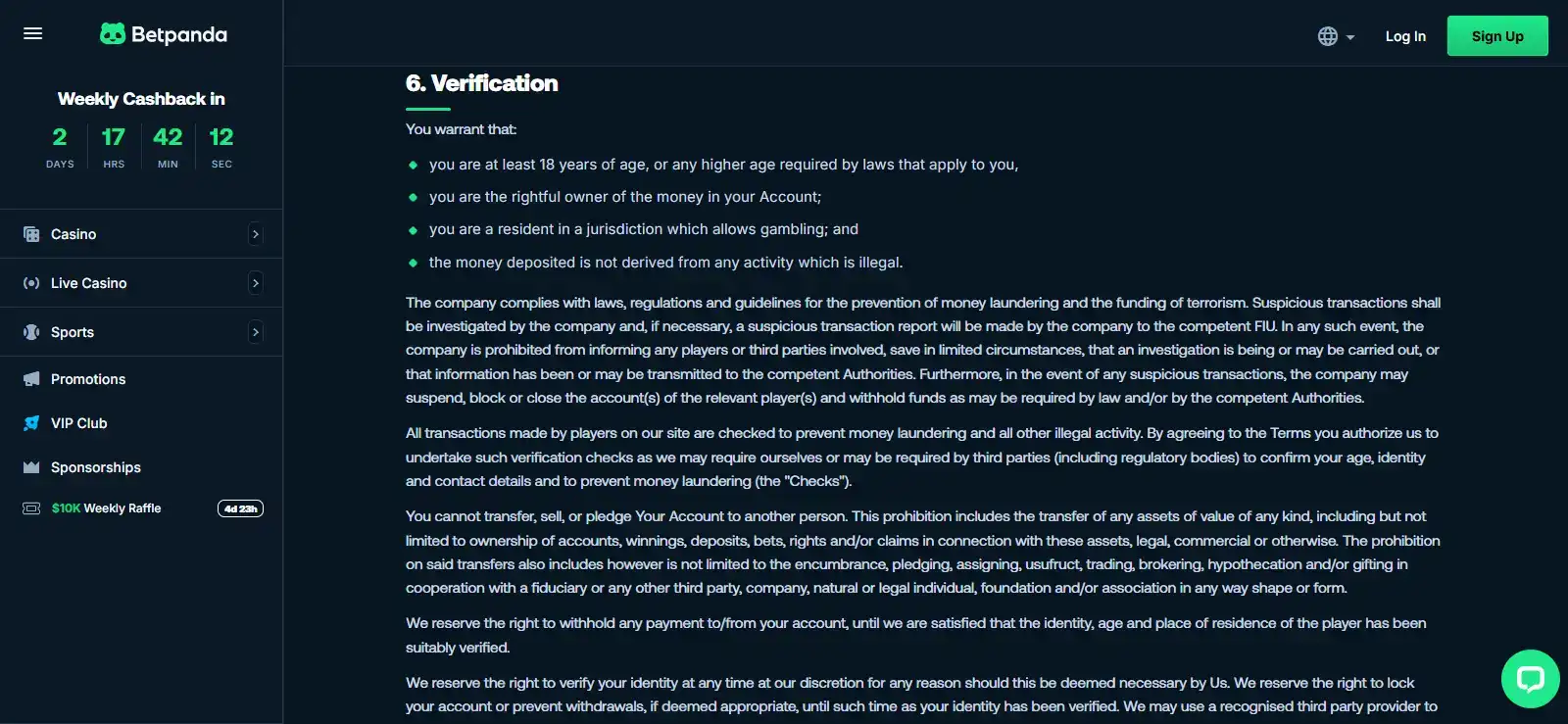
Table of Contents
- Conditional KYC is different from no KYC
- What can trigger a BetPanda verification request?
- The exact monetary threshold is not a stable public fact
- What documents can be requested?
- Source-of-funds checks are not the same as ordinary identity checks
- Verification can interrupt a withdrawal
- Registration remains a separate step
- Account behaviour can matter even before a withdrawal
- Do not send more information than the live request asks for
- How to distinguish a verification request from phishing
- How verification timing should be described
- KYC status does not answer the licensing question
- The verification questions BetPanda users should answer before cashing out
- Why verification can appear at different stages
Conditional KYC is different from no KYC
Current BetPanda material draws a distinction between registration and later verification. At signup, the operator describes a low-friction route that does not normally require a passport, proof of address or selfie before the first deposit. That is the part of the experience often marketed as “no KYC”.
The same official material also states that verification can be requested when specific triggers appear. A conditional model therefore means the check is delayed until the operator decides it is necessary, not removed permanently from the account lifecycle. The distinction matters most at withdrawal, because that is when a user may discover that the account has moved from routine processing into manual review.
What can trigger a BetPanda verification request?
The clearest operator-specific triggers in current BetPanda guidance are a large withdrawal, an AML or blockchain-analytics flag, and suspected multi-accounting or bonus abuse. Other official pages also refer more generally to unusual account activity or manual review.
| Trigger | Current official signal | What it means for the user |
|---|---|---|
| Large withdrawal | Repeatedly named as a possible KYC trigger | A cashout can pause while identity is checked. |
| AML flag | Named in current conditional-KYC guidance | Transaction patterns can prompt extra review. |
| Multi-accounting | Named as a verification trigger | Multiple accounts can lead to compliance checks. |
| Bonus abuse | Named as a verification trigger | Promotion-related behaviour can lead to manual review. |
| Unusual activity | Referenced in current withdrawal guidance | The operator can review activity outside routine play. |
The exact monetary threshold is not a stable public fact
BetPanda’s current KYC guide says the exact large-withdrawal threshold depends on internal compliance policy and market conditions. Other official content discusses broad industry thresholds, but those examples should not be converted into a guaranteed BetPanda trigger amount.
For that reason, this page does not publish a number at which KYC will definitely start. A user making a large withdrawal should assume a review is possible and check the current account settings or terms before relying on any older threshold quoted elsewhere. A threshold that appears in a blog article can also change without changing the basic conditional-KYC model.
What documents can be requested?
BetPanda’s broader KYC educational material describes common identity documents such as photo ID, proof of address or a selfie, but the current available information does not establish one universal BetPanda document list that applies to every account review. The exact request can depend on why the review was triggered.
This distinction matters because an industry example is not the same as a contractual checklist. If the account requests verification, the controlling source is the instruction displayed in the account or sent by official support. This page therefore avoids telling users to prepare a fixed bundle of documents in advance.
Source-of-funds checks are not the same as ordinary identity checks
Some gambling and financial reviews distinguish between proving identity and explaining where funds originated. The current BetPanda information does not support a universal source-of-funds checklist, so this page does not claim one. If a live account request asks for extra financial information, that request should be treated as a separate compliance step rather than assumed to be part of every KYC review.
This is another reason to follow the exact instruction presented for the account. A passport can establish identity, while a transaction history or other financial record answers a different question. Combining those into one generic “KYC documents” list can misrepresent what the operator actually requested.
Verification can interrupt a withdrawal
Current BetPanda withdrawal material says standard cashouts usually proceed without identity documents, while large or irregular requests can be paused for review. The separate withdrawal guide explains operator processing and blockchain timing; this page focuses only on the account-review layer.
A delayed cashout caused by KYC should not be confused with a blockchain delay. If the withdrawal has not yet been broadcast because the account is under review, waiting for network confirmations will not resolve it. The account needs to complete the operator’s verification request first.
Registration remains a separate step
The registration guide covers the current email-and-password signup information and the fact that the live form can change. Conditional KYC occurs later and should not be retroactively described as part of every signup.
This separation is useful because it prevents two opposite errors: claiming that BetPanda always requires full identity verification before play, or claiming that a fast signup proves documents can never be requested later.
Account behaviour can matter even before a withdrawal
Current official KYC guidance names AML flags and suspected multi-accounting or bonus abuse, which means a review is not limited to a simple cashout amount. Account patterns can become relevant even when an individual withdrawal is below an assumed threshold.
That makes it unhelpful to think of conditional KYC as a single hidden number. The model is better understood as risk-based review: several different events can move an account into manual verification, and the operator does not publish every internal rule used to make that decision.
Do not send more information than the live request asks for
If verification is triggered, follow the instructions inside the account or through the operator’s official support channel. Do not send identity documents to an address found in an unofficial forum post, direct message or unrelated review site.
The same principle applies to crypto credentials. Identity verification should never require a private key, seed phrase or wallet recovery phrase. Those secrets control funds and are not needed to prove ownership of an account or identify a public blockchain transaction.
How to distinguish a verification request from phishing
A legitimate request should connect back to the current BetPanda account, official support channel or official domain. Users should verify the domain before uploading any document and avoid links that arrive unexpectedly from lookalike senders.
If the request is unclear, the safer step is to open the official site independently and contact support from there. That avoids relying on a link embedded in an unsolicited message and gives the user a separate path to confirm whether the account is actually under review.
How verification timing should be described
The current available information does not establish a single contractual BetPanda KYC completion time. Some pages discuss fast processing in broad terms, but those claims should not be turned into a promise that every identity review will finish within a fixed number of minutes or hours.
Review time can depend on the reason for the check, the quality of submitted documents and whether the operator needs additional clarification. In practice, verification may delay a withdrawal, while the actual completion time should be taken from the live account request or the current BetPanda support response.
KYC status does not answer the licensing question
This matters because verification, payment speed and licensing are different trust signals. Combining them into one “safe” or “unsafe” label would hide the specific facts a UK reader may need to evaluate.
The verification questions BetPanda users should answer before cashing out
Before cashing out, check whether the account shows any review or verification notice and use the exact document request presented by the operator rather than a generic online checklist. Confirm that any verification request comes through the official account or official support channel, keep the withdrawal details and public transaction information, and never share private keys, seed phrases or recovery phrases. A large withdrawal or other risk trigger can make conditional KYC more likely, but the available information does not support one fixed trigger amount or universal document list. The account guide explains why simple signup should not be mistaken for a permanent no-KYC guarantee.
Why verification can appear at different stages
Conditional KYC means the timing of a check can depend on the account and the activity being reviewed. A user should therefore avoid treating a previous deposit or withdrawal without a document request as proof that verification can never be requested later. The useful preparation is simple: keep account details accurate, read any request carefully and provide information only through the account process shown by BetPanda.
Verification and withdrawal processing should also be considered separately. A document review can affect the account stage, while a crypto transfer has its own processing and blockchain-confirmation stages. Keeping those steps distinct makes it easier to understand where a delay is occurring and which information needs to be checked.
Follow the current account request.
Prepared by the Betpanda Casino editorial staff.